


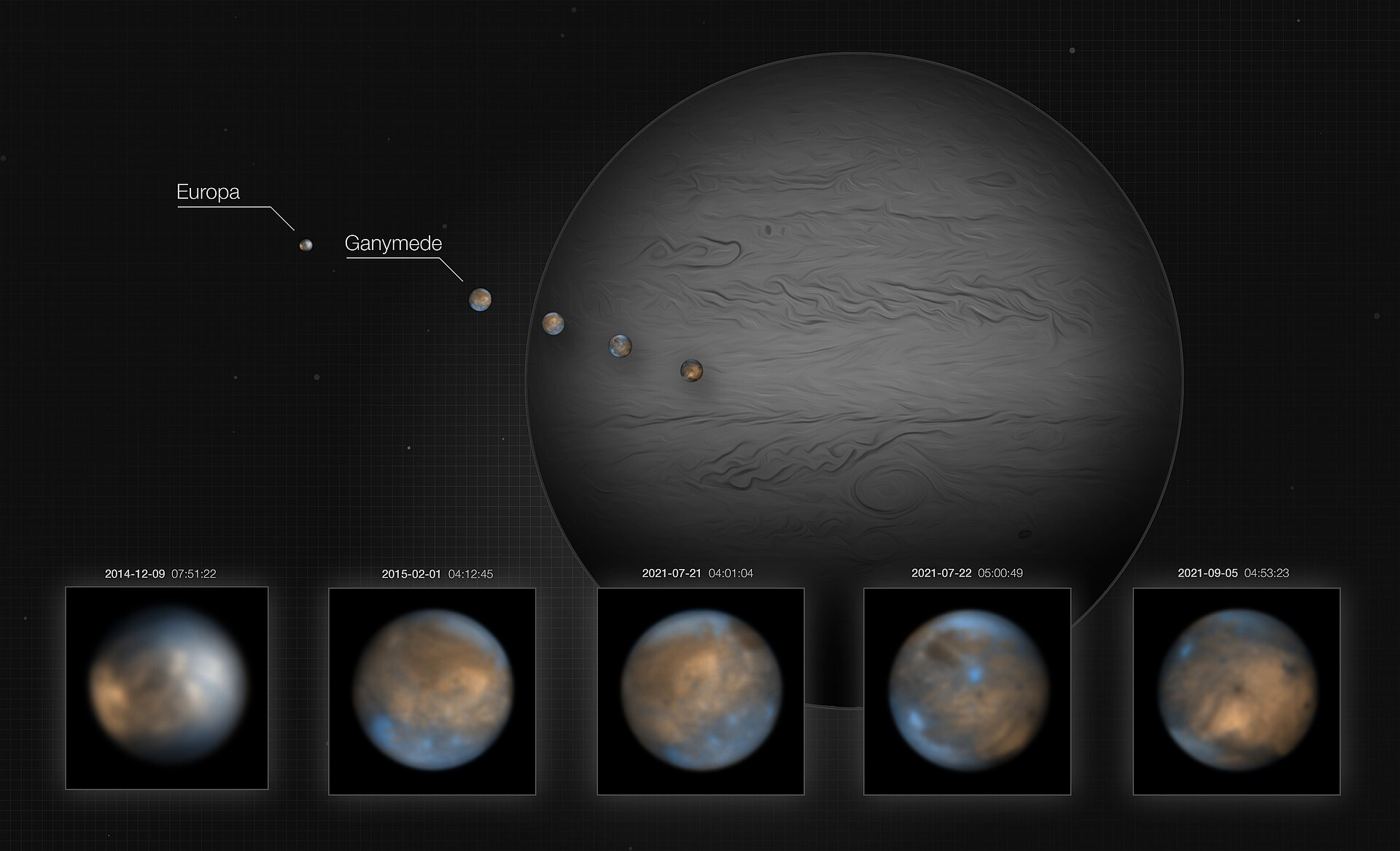
Beneath the bright, cracked ice of Jupiter’s moon Europa lies a salty ocean that may hold more water than all of Earth’s seas combined. Reaching that ocean directly would mean drilling through kilometres of ice, a task no mission can yet attempt. But Europa may offer a shortcut. Telescopes have detected faint plumes of water vapour rising from the surface, suggesting that ocean water occasionally vents into space through cracks in the shell. If those plumes are real and a spacecraft can fly through one, it could collect fresh ocean material without ever touching the ice. That prospect has shaped the plans of missions now travelling to Jupiter, which will make repeated close flybys of Europa, sniffing for vapour and mapping the surface for the most likely vent sites. Scientists say a single confirmed plume sample could reveal the ocean’s chemistry, including salts and organic compounds, in ways surface observations never could.
What the Evidence Shows
Confirming the plumes has proved difficult, because they appear intermittent and the early detections were faint. Some observations found vapour while others found nothing, leaving open whether the vents switch on and off with the tidal flexing Europa experiences as it orbits Jupiter. The approaching spacecraft carry instruments designed to settle the question, including cameras that can watch for bright spray against the dark sky and mass spectrometers that can taste particles during a flyby. Mission planners are also weighing the risks, since a close pass through a plume must be timed carefully and the radiation around Jupiter is harsh on electronics. Even without a plume encounter, radar will probe the ice shell for shallow pockets of water and map its thickness. Researchers caution that a sample would not prove life exists, only whether the ocean contains the ingredients and energy life would need. Still, they describe the plumes as the best available window into an ocean world that may otherwise stay sealed for generations. Reporting and analysis from sources such as National Science Foundation track the same developments, and specialists following the venting water plumes say the direction is now consistent across independent lines of evidence.
The Wider Context
The wider context is a research landscape in which replication and open data now decide reputations. Findings connected to the venting water plumes are being checked by independent groups with shared datasets, and the teams involved publish their methods in full so rivals can test every step. That discipline is slower than a headline cycle, but it is why results in this area increasingly survive first contact with scrutiny.
What Happens Next
What happens next in the story of the venting water plumes will be decided by follow-up work already under way: larger samples, longer observation and instruments that have not yet come online. The researchers involved are unusually united on one point, that the current results justify the next investment of time and money. Readers will not have to wait long for the first tests of that claim. You can follow related developments in our coverage of science.
There is a practical lesson in all of this for readers deciding what to do today. Start with the verified facts, be wary of anyone promising certainty, and prefer reversible steps while the evidence is still developing. Circumstances differ by country, income and personal situation, so general guidance should always be weighed against your own context before you act on it in any significant or lasting way.
