


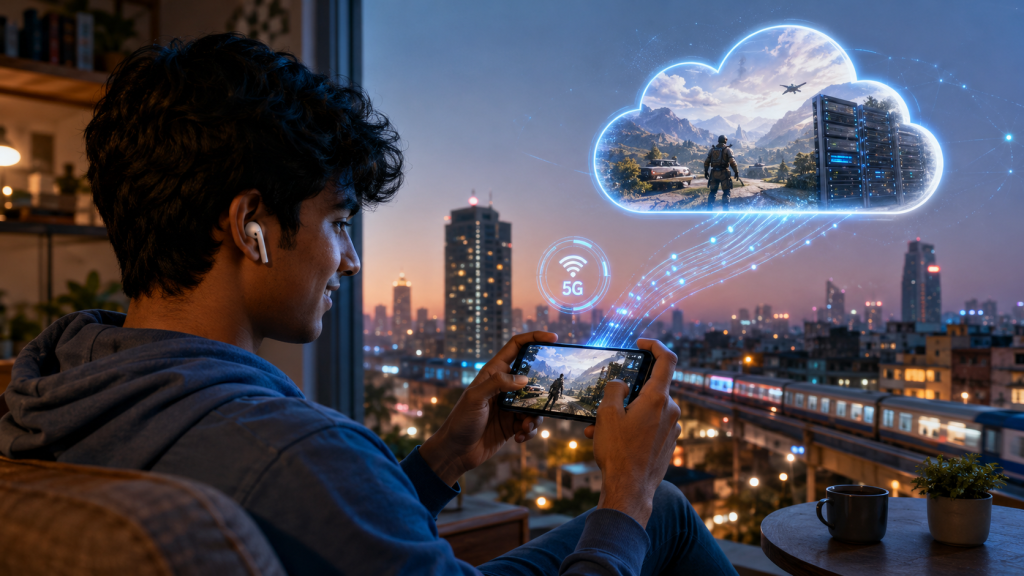
The promise of cloud gaming is especially appealing in India, where millions of people play on mobile, but buying a console or a powerful computer still represents a considerable investment. The current trend among Indian gamers is moving more and more towards immediacy, a kind of agility they already experience with lightweight formats such as the dynamic slots of online casinos that load instantly in a web browser. Now the cloud is trying to replicate that same ease of access without installations for big-budget video games, processing them in a data centre and streaming the image in real time directly to a smartphone screen.
The network is starting to be good enough
India ended 2025 with around 430 million 5G subscriptions, equal to 35% of the total mobile market, after a rollout that has brought coverage to almost every district in the country. Ericsson expects that figure to rise above 1.1 billion by 2031, when 5G could account for 81% of subscriptions, growth supported by the arrival of increasingly affordable compatible phones.
Data consumption also works in its favour. Each Indian smartphone uses an average of around 37 GB per month, the highest figure in the world according to Ericsson’s report, and that could move closer to 70 GB by 2031. India already has a culture deeply accustomed to video, live content and mobile applications, so streaming a video game does not require teaching the public a completely new behaviour.
The catalogue is no longer just a promise
Infrastructure would have little value without services capable of offering recognisable games, and this is where one of the most important advances has taken place. JioGames advertises access to more than 500 premium games in the cloud and allows users to run PC titles from smartphones, Android TVs and compatible set-top boxes, without heavy installations or the need for high-end hardware. Its catalogue includes names such as Hitman, Mafia, Just Cause 4 and Tomb Raider.
Microsoft officially brought India into Xbox Cloud Gaming at the end of 2025, expanding the service to 29 countries. At that point, more than two thirds of the Game Pass catalogue was enabled for cloud play, alongside the option to stream certain games already purchased by the user. The move is especially significant because it brings console games closer to mobiles, modest computers, televisions and streaming devices.
GeForce NOW also includes India among its available territories, strengthening an offering that for years depended almost entirely on local projects or limited trials. Competition between Jio, Microsoft and NVIDIA could help expand catalogues, improve servers and offer prices adapted to the market, although it will still be necessary to see how many users turn that initial curiosity into a stable subscription.
Latency still decides the outcome
Talking about 5G usually pushes the conversation towards download speed, but in cloud gaming what matters just as much, if not more, is how long a command takes to reach the server. A film can buffer several seconds in advance to avoid interruptions, while a video game has to respond almost immediately when the player moves a character, shoots or presses a button.
Xbox sets a minimum speed of 10 Mbps and notes that some devices may need 20 Mbps to achieve suitable quality, while also recommending a 5 GHz Wi-Fi connection. GeForce NOW requires 15 Mbps to play in HD at 60 frames per second, 25 Mbps for Full HD and 35 Mbps for QHD resolutions at 120 frames per second, together with latency below 80 milliseconds relative to its data centres.
Many Indian connections can exceed those speeds without difficulty, although a fast network is not always a stable one. Packet loss, sudden latency spikes and an overloaded home router can produce an experience far worse than a speed test might suggest, especially in shooters, fighting games or competitive titles where control has to feel immediate.
Saving on hardware comes with a less visible cost
The main argument in favour of cloud gaming is easy to understand, because it allows access to advanced titles without buying a console, a graphics card or an especially powerful phone. It also removes long installations and reduces the amount of storage used, which is a considerable advantage when many Indian users rely on devices with limited memory.
Even so, the cloud does not make gaming a completely free experience. The user may need a subscription, a compatible controller, a good home connection and a sufficient data plan, while many Xbox titles require physical controls, even though part of the catalogue supports touch controls or keyboard and mouse.
Data consumption also deserves attention, because streaming graphics for several hours requires maintaining a constant flow that can absorb a significant part of any limited plan. The average of 37 GB per month shows that India is a data-intensive market, but mass adoption of cloud gaming will need generous plans, home fibre, 5G Fixed Wireless Access and commercial bundles that combine connectivity and subscriptions.
India is ready to begin
India already has the basic ingredients for cloud gaming to stop being a curiosity: an audience of hundreds of millions of players, accelerated 5G deployment, huge data consumption and both international and local services offering increasingly serious catalogues. The situation in 2026 is very different from what it was just three years ago.
That does not mean the country is ready to abandon downloads or immediately replace games running directly on the device, because stability, pricing and latency still create major differences between users. The most realistic future will be hybrid, with installed mobile titles for competitive play and offline gaming, while the cloud opens the door to PC and console experiences that previously sat outside the budget.