


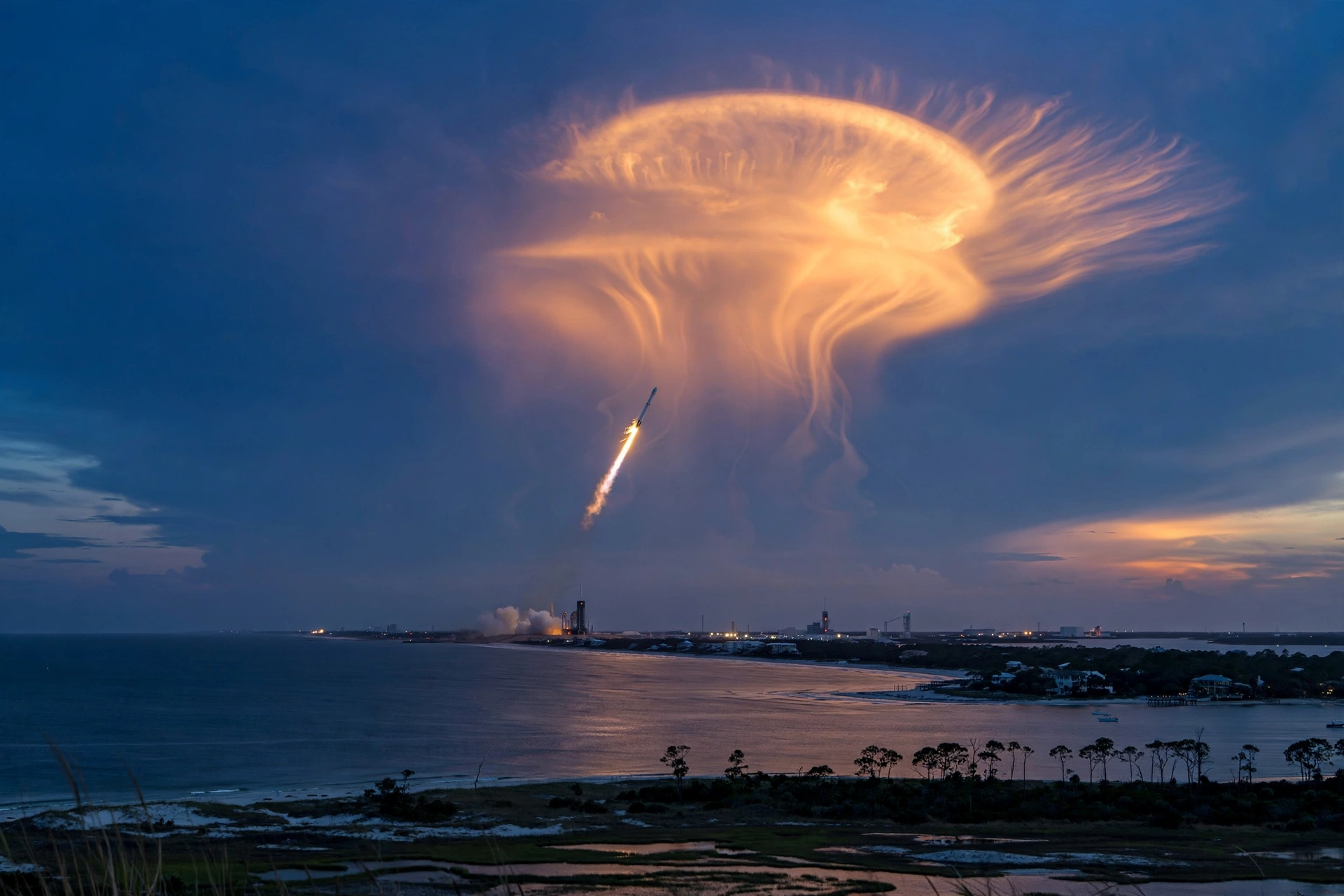
Skywatchers along the United States east coast were treated to an unusual and beautiful sight this week, when a SpaceX rocket launch created a glowing, jellyfish-shaped cloud high in the twilight sky. Photographs shared from beaches, rooftops and back gardens showed a soft, expanding plume with trailing tendrils, illuminated long after the ground below had fallen into dusk. For many people who saw it, the display looked almost otherworldly. For scientists and spaceflight watchers, it was a familiar, if rarely so vivid, effect of a rocket climbing through the upper atmosphere at exactly the right moment.
Why the cloud looked like a jellyfish
The so-called jellyfish effect happens when a rocket launches shortly before sunrise or shortly after sunset. At ground level it may already be dark, but at high altitude the rocket and its exhaust plume are still catching direct sunlight. The bright plume expands in the thin upper atmosphere, fanning out into a rounded head with wispy trails below it. Against a darkening blue sky, the contrast can be dramatic, which is why images from this launch spread so quickly online.
Reports collected by The Guardian described the cloud as visible off the US east coast, with witnesses watching the shape grow and drift for several minutes before it faded. That slow fade is part of the spectacle. Unlike a firework, the plume does not vanish in seconds. It hangs, stretches and thins as upper-level winds pull it apart, giving photographers time to capture it and giving casual observers time to wonder what they are looking at.
A reminder of how busy the launch calendar has become
Launches that once felt like rare national events are now a regular part of the news cycle on the Space Coast and beyond. Commercial missions, satellite deployments and crewed flights have made rocket sightings more common for residents in Florida and up the eastern seaboard. Yet timing still matters. A daytime launch is impressive for its sound and trail, while a twilight launch can turn the same physics into art. Readers following our recent coverage of airlines adding record winter routes as travel demand keeps rising will recognise a wider pattern: the skies above the coast are busier than they have been in years, whether for holidays, commerce or spaceflight.
SpaceX and other operators publish launch windows in advance, but weather, technical checks and range availability can move a liftoff by days. That uncertainty makes spontaneous sightings especially memorable. People who happened to be outside walking a dog, finishing a run or watching the sunset were the ones who caught this display first, before alerts and social media posts sent others rushing outdoors.
What to look for next time
If you want to see a jellyfish cloud yourself, experts suggest watching for launches scheduled in the hour after sunset or the hour before dawn, then looking toward the launch site with a clear, dark horizon. Binoculars are not required, although they can reveal structure in the plume. A phone camera on a steady surface will often capture more colour than the eye alone, because it can gather light over a longer exposure. It is also worth staying patient: the most striking shapes often appear several minutes after liftoff, as the vehicle reaches higher altitude and the plume expands.
There is also a practical point for anyone planning to travel to watch a launch in person, a theme we explored in how businesses can earn attention in a crowded news cycle. Coastal towns now prepare for launch tourism, with viewing spots filling early and local businesses extending hours. Checking official updates on the day remains essential, because a scrubbed attempt can still end with an empty sky.
Beauty, with a serious mission behind it
Behind the beautiful images is a working mission, part of a launch programme that supports communications, research and national infrastructure. Information about upcoming missions and vehicles is published by SpaceX, and each flight adds to a growing record of reusable rocket operations that have changed the economics of reaching orbit. The jellyfish cloud does not change that mission, but it does change how the public experiences it. For a few minutes, a technical operation became a shared moment of wonder for thousands of people who simply looked up.
As more twilight launches are scheduled in the coming months, the east coast may see the phenomenon again. When it happens, the advice from this week is simple: step outside, look up early, and give the sky a few minutes. Some of the best views in modern spaceflight are not through a telescope at all, but with the naked eye, standing in the gathering dark while a cloud made by a rocket glows above the sea.
