


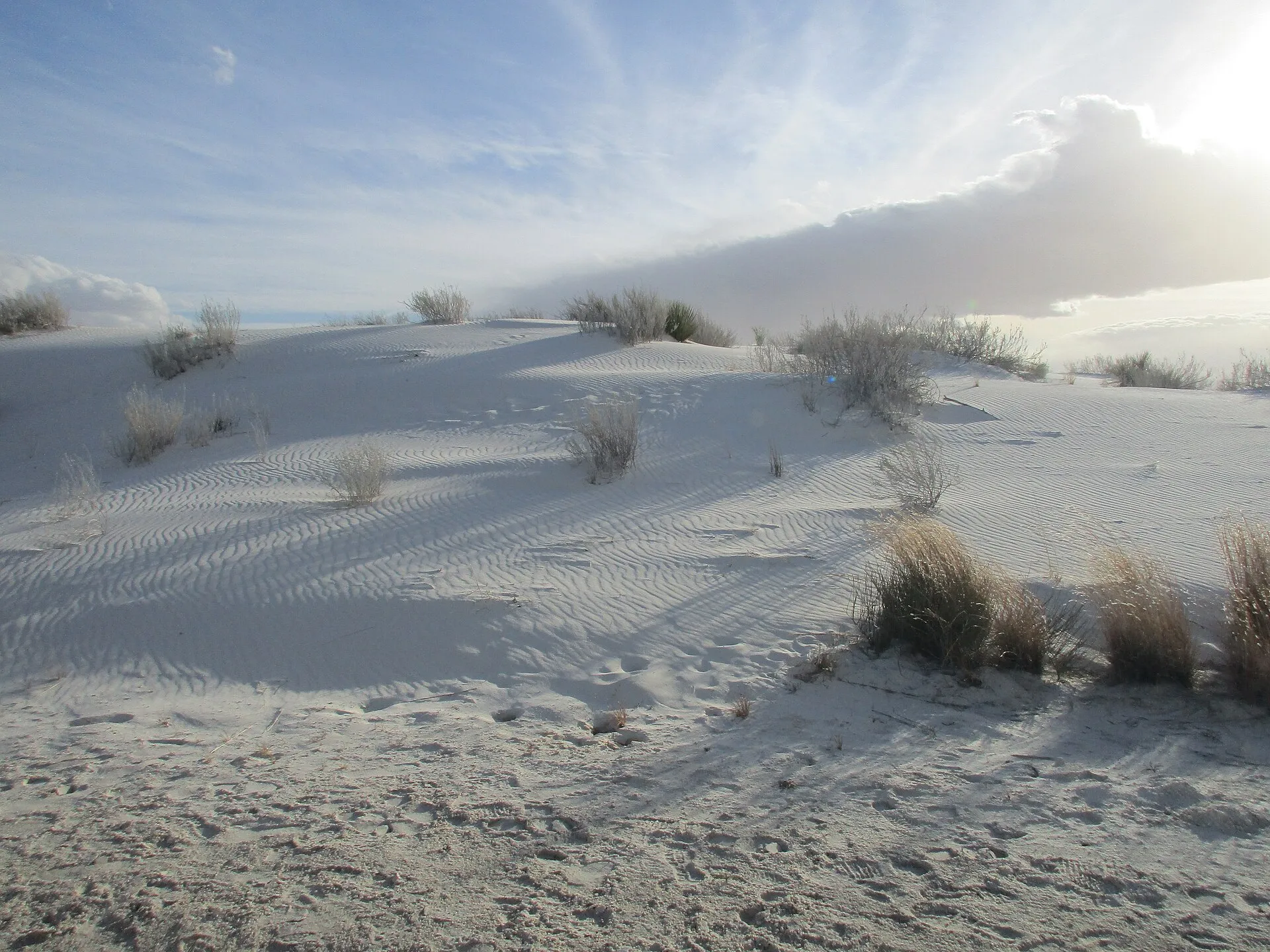
It is one of the most striking scenes in American archaeology: human footprints pressed into the shore of an Ice Age lake, preserved for more than twenty thousand years in the gypsum of White Sands, New Mexico. A new study in Science Advances now reconstructs the world those footprints were made in, and finds it was a place of abrupt environmental change.
The research, DOI 10.1126/sciadv.aeh0707, focuses on the Last Glacial Maximum, the coldest phase of the last ice age, and on ancient Lake Otero, which once occupied the Tularosa Basin. Using sediment records and environmental proxies, the team tracked how the lake and its surroundings responded as the climate shifted.
Water That Came and Went
The basin’s story, the researchers found, was one of fluctuation. Lake levels rose and fell, shorelines moved, and the mix of plants around the water changed over time. Each shift would have redrawn the map of daily life for the people and animals using the basin, moving drinking water, grazing areas and hunting grounds.
Footprints at White Sands, dated in previous studies to roughly 21,000 to 23,000 years ago, show adults and children walking the lakeshore, sometimes alongside tracks left by mammoths and giant ground sloths. The new environmental record suggests those walks took place against a backdrop of repeated, sometimes rapid change.
What Survival Required
Archaeologists say coping with that instability would have demanded flexibility: knowing multiple water sources, moving camp as shorelines shifted, and exploiting a broad range of foods rather than depending on a single species. The full study is available from Science Advances.
The findings add weight to a growing view that the earliest Americans were highly capable adapters. Rather than arriving in a static, empty continent, small groups appear to have read changing landscapes closely and adjusted their behaviour generation after generation.
In other research news this week, our team reported that the US Measles Total Reaches 4,410 After 8 Percent Weekly Increase, a reminder that careful measurement often overturns easy assumptions.
An Unfinished Story
How the Team Rebuilt a Lost Climate
Reconstructing a climate from 20,000 years ago is an exercise in triangulation. The researchers combined physical sedimentology, which shows how deposits were laid down, with geochemical and biological indicators that respond to water and temperature. Where the indicators agree, confidence grows; where they differ, the team can map the uncertainty honestly rather than hiding it.
The resulting timeline gives the footprint discoveries a chronological spine. Instead of asking only how old the tracks are, scientists can now ask what the weather was doing in the centuries when particular trackways were made, a far richer question, and one that turns White Sands into a laboratory for studying human behaviour under environmental stress.
For readers encountering White Sands for the first time, the geography helps explain the science. The dunefield sits in a closed basin with no outlet to the sea, so water that entered during the Ice Age stayed until it evaporated, concentrating minerals and recording every fluctuation in the sediments it left behind. Few landscapes preserve such a complete diary, which is why geologists and archaeologists have converged on the same stretch of desert from different disciplines and found their evidence interlocking.
The work also has a practical edge for the park today. Understanding how the basin’s ecosystem responded to past climate swings helps land managers anticipate how the modern dunefield and its species might respond to present-day change. In that sense the Ice Age record is not only about the deep past; it is baseline data for the future of one of America’s most unusual protected landscapes.
Scientists stress that White Sands still holds unanswered questions, from exactly how the footprints relate to nearby occupation sites to how the basin’s people connected with groups further afield. What the new study does settle is the setting: at the height of the last ice age, in a basin of shifting lakes and restless climate, people were there, and they stayed.
